

Why it’s so difficult to count our blessings
We Remember Every Struggle but Forget the Breeze at Our Back 💨
In a nation that loves cycling, I remember my first long distance cycling trip to the Belgian coast. After covering a distance of 73 kms, we were riding the final few kms to our campsite. I had felt physically strong until … the coastal winds hit - the loud, constant headwinds struck like a slap on the face. I remember I could not focus on anything but cursing the wind and hoping for it to stop. Even slowing down my pace to a bare minimum did nothing to reduce my suffering or annoyance. With the campsite at a walking distance, I got off my bike and gave a big bombastic side-eye 👀 to the weather gods and walked the final hundred metres in a stomping fury.
On the return trip, that same wind became a helpful tailwind. That day we covered more than 90 kms and still felt strong at the end. Surprisingly, my mind initially tried to discard the tailwind’s role in enabling the increased distance and my remaining strength. I had to force myself to recall the insane difficulty of cycling against a powerful headwind, even for a single kilometre, regardless of one’s strength.
While the headwind tested my mental endurance, what struck me most was how its impact overshadowed any gratitude for the tailwind. My mind magnified the struggle and minimised the aid.
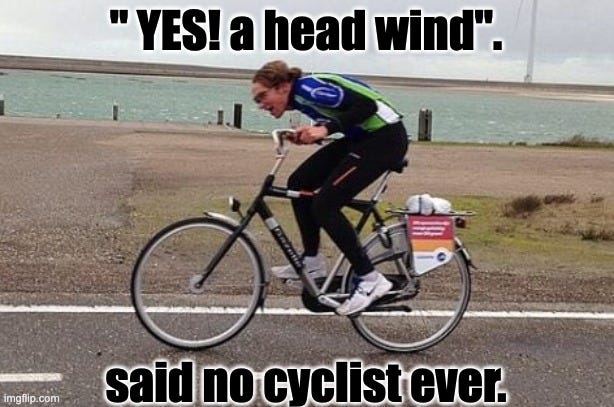
Maybe this specific cycling experience is familiar to you. If not, worry not! There are many such examples in every day life. Many of us, including myself, narrate the story of our lives through the lens of our (very real) 'headwinds’: struggles and barriers, both ongoing and conquered. Important to note that this is not limited to a specific societal marker - everyone does it. The rich & poor. The beautiful and ugly. Skinny and fat. Athletes and the rest of us. The famous and unknown. It’s beyond nationality, beyond race, beyond gender. I find it everywhere in friends, family, acquaintances and most certainly on social media.
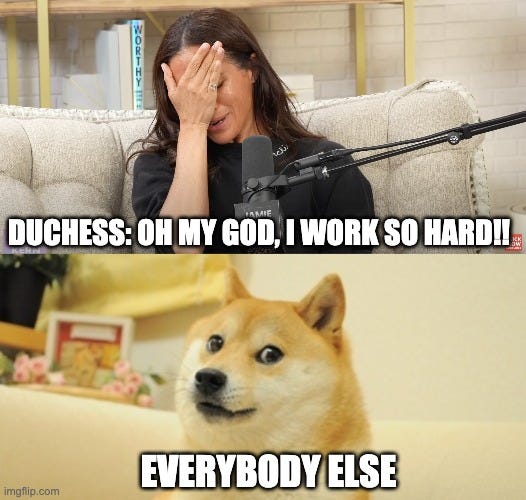
Before we rush to judge others for yapping about their seemingly insignificant problems (a temptation we might not resist), it did pique my curiosity: Given its abundance, is there a structural basis for this behaviour? Why do we define ourselves through our problems? And do our brains have a reason to discriminately pay more attention to everything goes wrong vs everything that went right?
Yep, you guessed it - there is.
📔 Introducing: the headwinds and tailwinds asymmetry
The phenomenon is known as the headwinds/tailwinds asymmetry, an availability bias in people's assessments of the benefits they've enjoyed vs. the barriers they've faced. Barriers command more attention because they have to be overcome. Being prominent to the brain, they come to mind more easily. Benefits and helpful resources can often be simply enjoyed while largely being ignored.
🔗 Paper by Shai Davidai & Thomas Gilovich
🧠 So no, You're Not Just Ungrateful
Not feeling grateful is not a personal failing. It makes evolutionary sense (at least most of the time). Our brains are wired in ways that promote this asymmetry especially since focusing on challenges is crucial for success.
Gains in efficiency: To navigate the world effectively, your brain prioritises addressing obstacles. It often filters out the benefits we receive in order to conserve energy for the immediate problems that need solving. This means advantages are easily overlooked.
Boost self-image: We all want to feel good about ourselves. Focusing on the struggles we've overcome reinforces a positive self-image, highlighting our resilience and capability. It's a natural way to build and protect our sense of self-worth.
💡AHA! Recognisable moments of H/T asymmetry in action:
A random injury makes you appreciate a healthy back or shoulder, but this gratitude often fades quickly once healed.
You're furious at a traffic jam when running late, but rarely feel a surge of gratitude for miraculously clear roads.
An exceptionally tough exam feels unfair and frustrating; a surprisingly easy one that goes well is often credited to intelligence and prep rather than the exam's simplicity.
Siblings often think that the other one had it easier with their parents while it’s impossible for both of the siblings to have it easier.
This isn't just anecdotal; One study found that when presented one difficult and one easy task in equal measure - people are more likely to remember and attend to difficult tasks or challenges, making them feel like they're spending a considerable amount of time fighting against them.
⚠️ This bias is harmful for me when
I start believing the obstacles I face are significantly harder than those others encounter, leading to feelings of isolation or unique hardship.
It tempts unethical behavior due to perceived unfairness: Studies indicate that when headwinds feel unjust (and it's true, sometimes they are), I might feel more justified in cutting corners or acting in ways that are ethically questionable.
🦋 Ripple effects in the contemporary world
The headwinds/tailwinds asymmetry (H/T asymmetry) doesn't just operate on an individual level; its ripple effects can be seen in broader societal and global dynamics:
🙋🏻 ME, ME, ME:
When the H/T asymmetry becomes extreme such as in the identity culture wars between extreme left and right of the political spectrum: an overemphasis on personal "headwinds" leads to individual experiences being seen as paramount and beyond question. This may contribute to a "victim mindset," where one's own challenges are perceived as uniquely severe, making it difficult to engage with differing perspectives or acknowledge one's own helpful "tailwinds.”
📈 Erosion of Empathy:
This bias can erode empathy. If a group becomes heavily focused on its own perceived disadvantageous "headwinds", it may struggle to acknowledge or empathise with the distinct challenges faced by other groups, or even recognise the advantages or “tailwinds” that all groups invariably experience to some degree.
Take for example the emergent manosphere’s questioning the fight for gender equality or affirmative action becoming more polarized when each side magnifies its own obstacles while minimising those of others. Furthermore, the current contention around DEI initiatives can fuel resentment and pushback, especially when such initiatives are perceived by some primarily as an 'unfair tailwind' for certain groups rather than as a corrective measure for existing systemic 'headwinds' faced by others.
🌎 Skewed global comparisons
Developed countries might be exhibiting H/T asymmetry when they downplay the hardships faced by developing nations, ignoring the benefits (tailwinds) received from centuries of accumulated knowledge, technological advancements, and political stability. Many of them also have a history of colonialism and exploitation that may have created disadvantages for other nations. For example, developed nations may recommend policies and institutions that were not used in their own development OR attribute the inability of developing nations to solve their problems to be innate to it’s people or race or culture, etc
💯 Blindsided by meritocracy
A strong belief in pure meritocracy can be a significant blind spot created by this asymmetry. When individuals attribute all their success solely to personal merit and effort, they may fail to recognise the "tailwinds" like supportive environments, inherited advantages, access to wealth, mentorship, opportunities or systemic privileges, that contributed. This makes it harder to acknowledge the often invisible systemic challenges that others face due to their gender, caste, race, sexual orientation, etc that impede them, regardless of their individual merit.
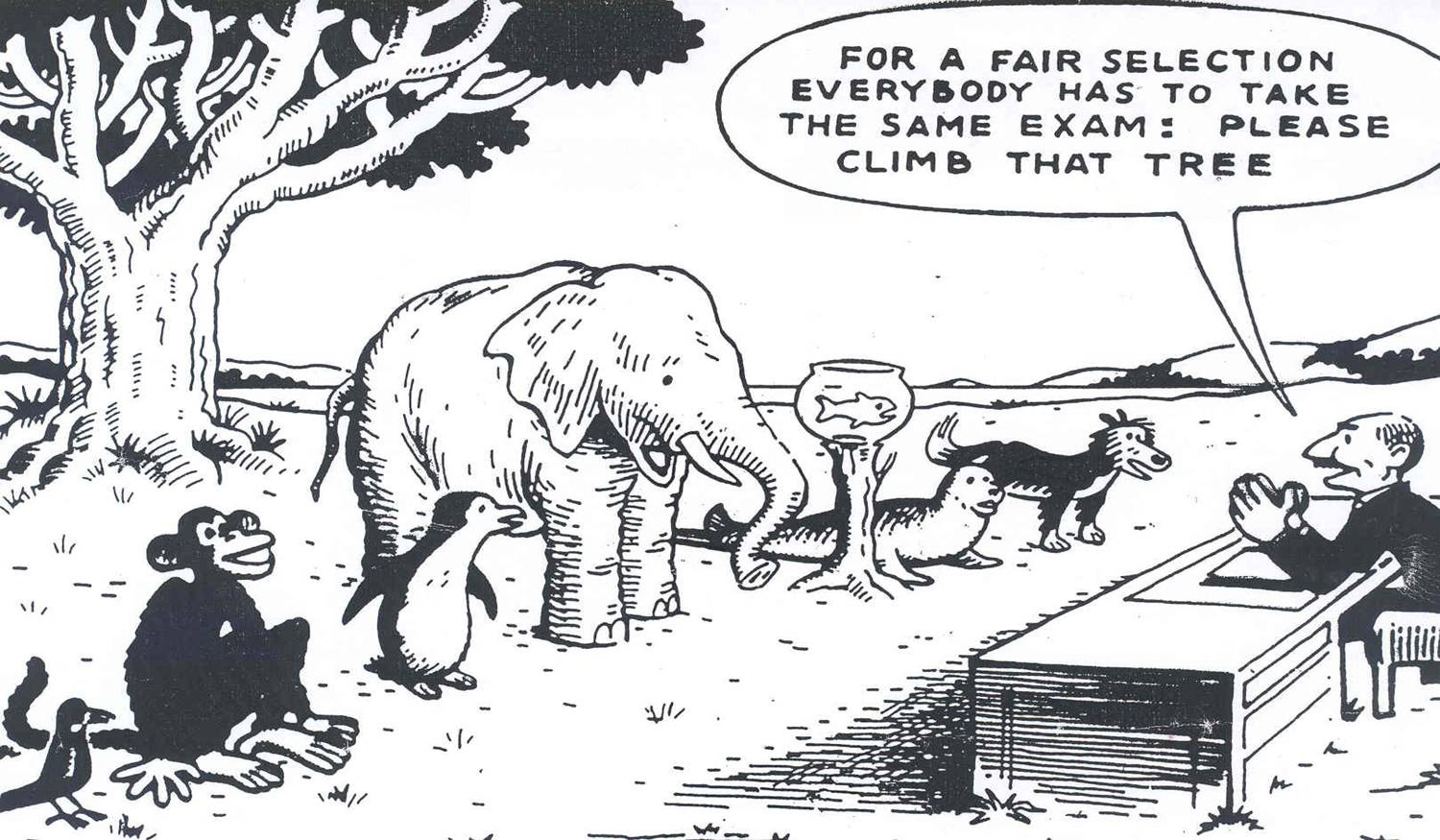
✨ Awareness does most of the work
This little cognitive bias can collectively have far reaching consequences. As overwhelming the scale of those problems are, don’t worry. For the most part, cognitive biases are here to protect us and increase efficiency. When the threat of a bias harming us arises, little awareness can go a long way.
🎉 Congrats! By the simple act of reading, you now have the awareness needed for a more balanced perspective next time you face H/T asymmetry!
Optionally: I’ll leave you with few small behavioural practises that can help you keep a more balanced perspective when you, your community or society is threatened by the harms of this cognitive asymmetry.
🤌🏻 Stay curious
Step out of your harmonious bubbles from time to time to interact and listen to people whose life experiences and stories stand in stark contrast with yours. Instead of a comparing their struggles to yours, immerse yourself by asking questions and make this an act of active listening.
📊 Evaluate your headwinds and tailwinds
Make a deliberate effort to see the constant tailwinds that help you, specially when you come across someone who does not have them. When you feel jealousy, contempt or ill-will towards someone with unfair tailwinds, examine if they really had any influence on control over acquiring these advantages.
🌷Note your blessings from time to time
While you may not have them top of mind, it can help to consciously bring yourself to recall things/people/places/communities/resources you are grateful for. Savour the good moments when they happen.
🍃 Reframe problems
At some point, one no longer feels the need to put their problems as the centrepiece. Understand and operate in your sphere on influence and use meditation or mindfulness practises to cultivate a peaceful acceptance of what you cannot control. Progress won’t be linear.
Curious if you already knew about the headwinds & tailwinds asymmetry? Let me know through this simple poll!
THANKS FOR READING! 🫶🏼
🔗 This post was inspired by
Original paper: The headwinds/tailwinds asymmetry: An availability bias in assessments of barriers and blessings.
Nice one Sonal! I do believe tailwinds become more appreciated when getting older.