

From one maximizer to another
From Maximising to Satisficing. I’m learning the art and science of feeling satisfied in life.
I suffer from the Malady of Maximising. I just learnt that word. The whole time I was calling it Over-optimizing until I found a study where apparently, there is a word for it. So Maximizing. It’s that desire for making or doing everything as good as possible. Whatever ‘good’ means.
The simplest definition I can think of is the tendency to keep putting effort into things long after it hits the point of diminishing returns.
It’s different from perfectionism. Perfectionists are hyper-focused on the results. Not always caring about the means to the result. They have a need for things to be flawless, they have a clear definition what flawless means and they won’t feel satisfied until they achieve it.
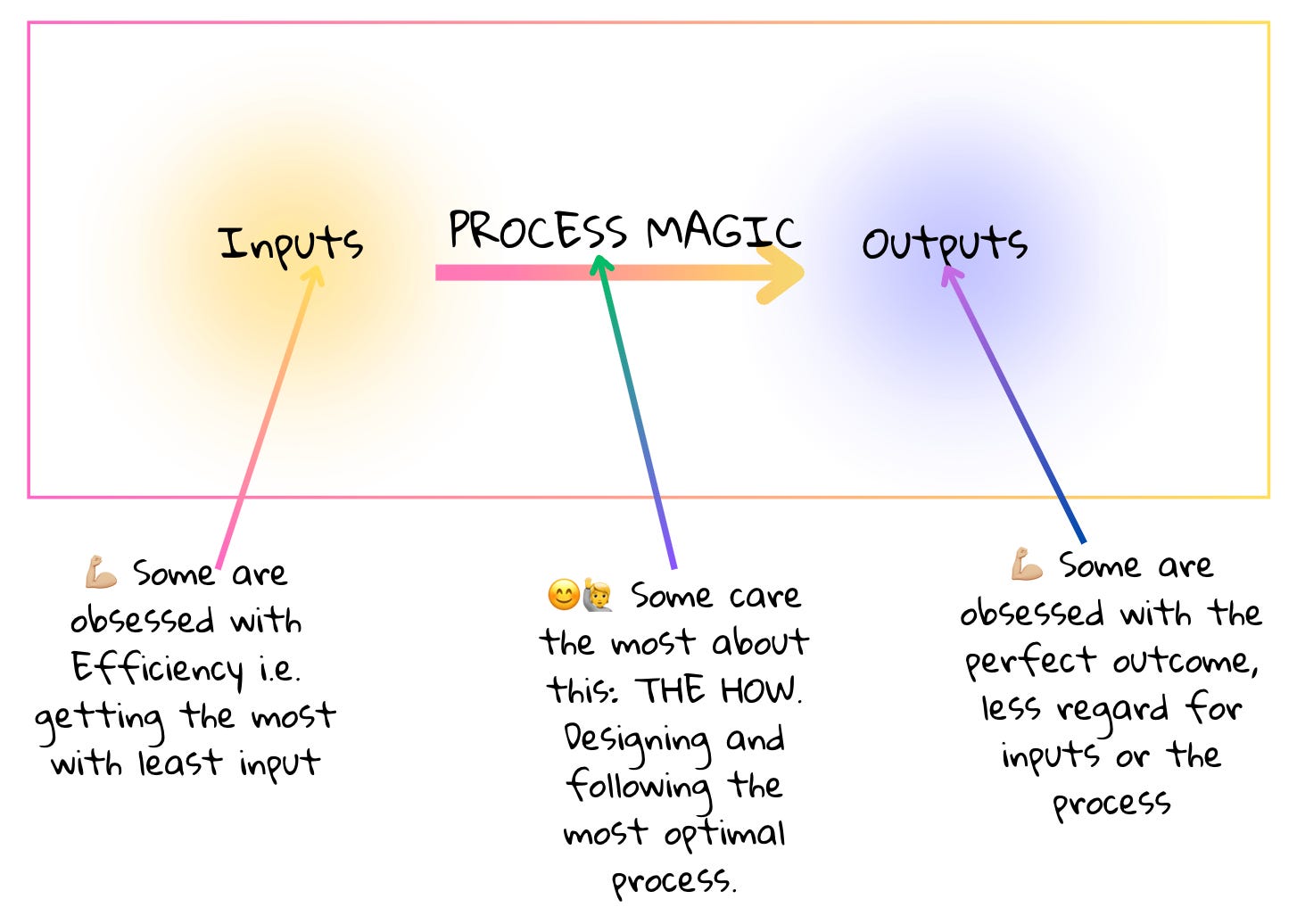
I am less fixated on the results themselves because I’ve had this belief: If I follow the most optimal path, if I do all the steps right, that outcome will take care of itself. So it’s the HOW side of the equation that usually gets to me. The effort side, the way of doing things side.
“Always doing your best” “Always striving for efficiency” “Always finding the shortest, fastest, most optimal path” That sounds like a low-key flex, doesn’t it? Am I just giving myself a back-handed compliment?
Um, no. I wish I was.
Why am I like this? Of course there is a reason, a backstory. The details don’t matter but in order to become a maximizer, I had to believe that it was desirable. And so I did, for the majority of my life. I thought there wasn’t a downside.
Turns out, there is a downside.
Maybe one of your parent maximized everything — from groceries to every minute of the day, from friendships to work decisions, from holiday itinerary to meal planning. Sometimes its not explicitly taught but indirectly: high effort is rewarded and suboptimal paths are punished or questioned. A child doesn’t even need to be punished to learn this trait. You may be lenient on your child but extremely tough on yourself and children will subconsciously pick that up and model that behaviour.
✅ Find out if you’re an optimizer:
Whatever our unique backgrounds and history that led us here but Maximizers share some traits:
Do you have a deep desire to do things “the right way”?
Do you have the urge to tell someone that there is a shorter, faster way of doing what they are doing?
Do you have a high starting inertia? Meaning that you find it difficult to start on things because you procrastinate — knowing subconsciously that your optimal process will take way longer than a quick and dirty way?
Do you have difficulties with quick and dirty solutions to problems?
Do you always reason from the ground up? Do you tend to cover all grounds?
Is it hard for you to share your “work in progress”?
When someone shows you something — do you feel very curious about how they did it or only care about the results?
Do you feel exposed or called out when someone finds a more optimal/faster/cleverer way of doing something you had already optimized?
If the answer to most of these questions is Yes, then you might be an Maximizer my friend!
The fine line between strength vs. weakness
I am not abandoning camps, dear fellow over-optimizers and I will firmly stay footed here. I deeply care about “how” and “the means” to get to a result. Rather I have realized that there is a fine line across which this wonderful trait can go from being a strength to a weakness.
In reality, we have multiple interests and responsibilities competing for our attention and there’s no neat way to split them up. Every hour you spend optimizing one thing is an hour you’re not spending on something else. You’re implicitly assigning a priority you might not explicitly agree with. And what starts as a joyful process of “doing things as well as possible” can quietly become a trap where you’re stuck in the process itself. A benevolent desire becomes a source of anxiety.
Add time to the equation. We have a limited supply and an unlimited number of things wanting a piece of it — and a fixed mindset in either direction becomes dangerous. What we actually need is agility. The ability to recognize where we are on the curve and shift accordingly.
Secret Admission: Sometimes, I optimize because I procrastinate
To the world, It looks like sincerity. “She has all fronts covered” “She thought of everything” and hearing that is great for my ego but deep inside ... sometimes, not all the times, I optimize and tinker the thing not because I should but because I am not ready to move on.
I feel safe in this thing now. I have spent time on it and the next thing .. is uncertain. I know I’ll need to put in all that mountainous initial effort again and its easier to keep on tinkering and follow my process rather than accepting that I have reached the point of marginal returns and must, infact, move on.
Which is what brings me to how I am breaking out of this:
Understanding the utility curves
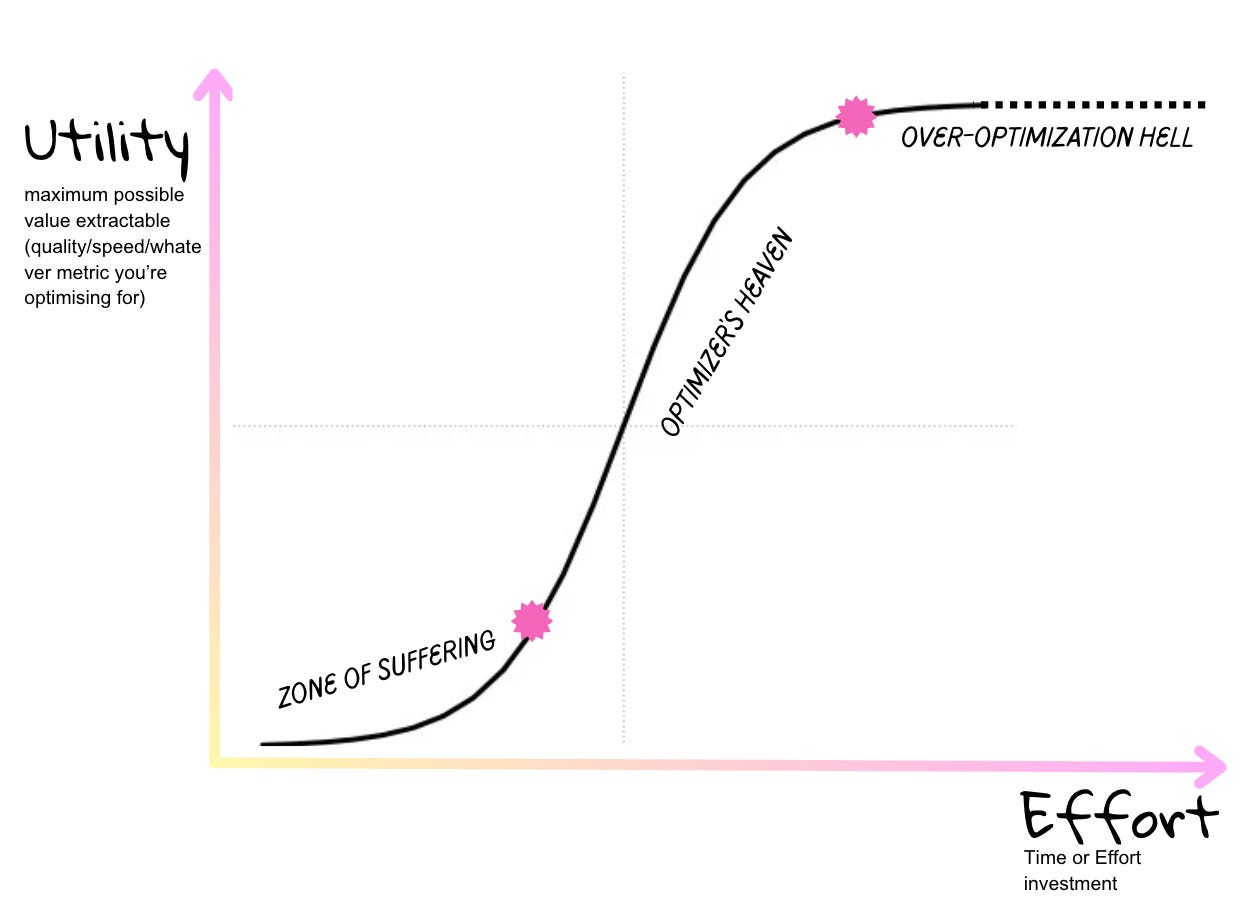
Self-explanatory but to state explicitly: Effort does not follow a linear relationship with Utility. Utility being an all encompassing term for Value or the Key Metric or whatever it is you are trying to Optimize. Utility is the subjective quality that makes you say “that’s what good looks like”
speed: the fastest way to do something
monetary value: the least expensive or highest monetary value created
joy: most joyous or pleasurable way to do something
flavour: Reaching peak flavour in a dish
quality: highest possible quality as outcome
Score: highest possible score
…. etc
Whatever your definition of utility might be, You’ll most likely go through 3 phases in this S curve:
🥵 SUFFERING
For most things, the initial effort leads to little or no value. You go to the gym 1ce or 3ce and you see absolutely no visible effects on your body. This is the zone of suffering. The only way to emerge on the other side is through belief or discipline.
🤩 JOY
This is the optimizers heaven. After crossing that minimal threshold, effort starts to almost linearly improve utility. I love being in this phase as you can immediately reap the fruits of your action. Being 3rd month on your training program, training starts to feel natural and you see yourself getting better.
😮💨 FRUSTRATION
And then you hit this. The over-optimisation zone. Effort no longer increases utility. You feel a bit stuck, a bit caged. This zone is the most unintuitive one because in real life, you can’t know for sure if you’re in it. Now you’re just extending your training program even though you are ready to compete. You keep waiting to feel ready but the feeling rarely comes. Be careful as this is where fatigue creeps in.
Breaking out: From Maximizing to Satisficing
Bringing it all together, there are a couple of highly practical tactics I use to get myself out of the Over-optimizing hell. To be clear, I am not there yet so if you’ve discovered nice tricks, please do share them with me.
⏰ Timebox & Artificial Deadlines
I don’t know why it works but there is something beautiful about putting imaginary pressure on myself that really forces my brain to get out of the “checkbox” rut and forces me to evaluate things faster, make decisions and move on - stopping at the perfect utility-effort point on the curve.
Turns out, In a survey of 100 productivity hacks, time-boxing was ranked as the most useful (Harvard Business Review) and research shows it works precisely because of Parkinson’s Law — time pressure pushes people to simplify decision-making.
Concretely, instead of stating tasks as “I’ll do X”, I force myself to say “I’ll do X for 1 hour” When you know there is an end to it, you enforce clarity.
Making external commitments is also a way of setting an artificial deadline but slightly more “scary”. If you said to your partner, this will be done in a week but a week turns out to be totally unrealistic then you end up looking inconsistent — humans hate feeling that way and that can be a source of anxiety.
🤝 Make the trade-offs explicit
After some effort has gone into a task, make the tradeoffs explicit. Are there other higher utility things you could be doing. Sometimes just framing the decision differently can spur you into action.
For example - I’m into my 8th hour writing a newsletter piece. I am tinkering at this point, definitely in the zone of marginal or diminishing returns. Reframe: Should I keep on writing or go do my exercise now? The clarity that this tinkering comes at the cost of exercise forces decision.
😇 Exposure therapy to Satisficing
This is not a real therapy, I made it up. But if you’ve been maximizing your whole life, you’ll need to start with low-stakes exposure to learn how to stop your efforts well BEFORE it feels natural. Seems trivial but is super critical because low-stakes exposure to Satificing (the art of finding balance on the effort x Utility curve such that it leads to a sense of satisfaction) is slowly going to prepare you for the high-stakes.
Bottom line is that we don’t need to spend our entire lives chasing an utopian result that will never come. Utility does not increase infinitely with Effort. It wanes off. Not only that, if we’re honest, it does not even feel good anymore. It feels like we’re checking a box but we know deep inside that this box makes no sense anymore. Maybe this is just a very meta way of me maximizing again but hey, I’ve reached the point where feeling satisfied and working on the highest leverage things in my life is more important to me than to maximize every decision or task that I undertake.
Eager to hear your thoughts! Write to me or leave a comment ❤️